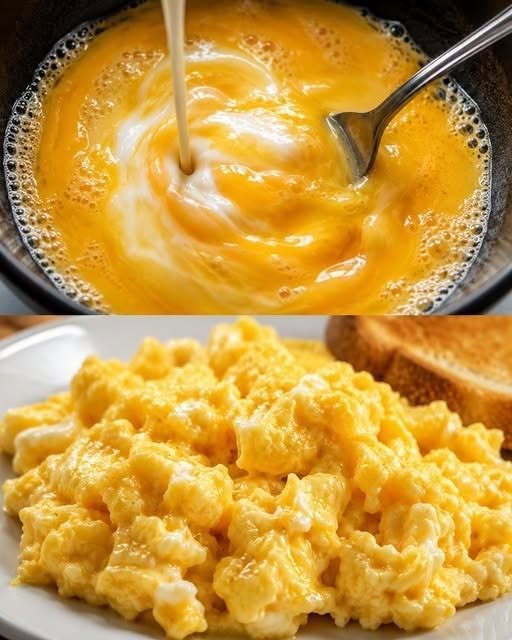
Perfect Scrambled Eggs
Prep Time: 5 minutesCook Time: 8 minutesTotal Time: 13 minutesYield: 2 servingsEquipment Needed8-inch or 10-inch heavy-bottomed nonstick skilletHeat-resistant silicone spatulaMedium stainless steel or glass mixing bowlFine-mesh whiskIngredients4 large fresh eggs (preferably pasture-raised or organic)1.5 tablespoons unsalted butter (divided: 1 tablespoon for cooking, 0.5 tablespoon cold for finishing)1 tablespoon heavy cream or whole milk (optional, for added richness)1/4 teaspoon fine sea salt (or kosher salt)Freshly cracked black pepper (to taste, for garnish)1 tablespoon fresh chives, finely snipped (optional, for garnish)Step-by-Step Cooking Instructions & Heat IntensitiesPhaseDurationHeat IntensityAction & Objective1. Preparation2 minOff / Room TempCrack eggs into a bowl. Whisk vigorously for 60 seconds until completely uniform and homogeneous with no visible white streaks.2. Seasoning & Pre-Heating1 minLow-MediumAdd salt and optional cream to the eggs; whisk again. Melt 1 tablespoon butter in the skillet until foamy but not browned.3. Initial Set2 minLowPour egg mixture into the center. Let sit untouched for 20-30 seconds until the outer edges begin to set subtly.4. Curd Formation3 minLow to Very LowGently sweep the silicone spatula across the pan bottom in long strokes, forming soft folds. Control heat by sliding pan off burner if cooking too fast.5. Finishing Touch1 minOff HeatRemove pan from heat while eggs are still slightly wet and glossy. Fold in the remaining 0.5 tbsp cold butter to arrest cooking.6. Plating1 minOff / ServingTransfer immediately to warm plates. Garnish with cracked black pepper and fresh chives.Cooking Process BreakdownStep 1: Whisking to HomogeneityCrack the eggs into a glass or stainless steel bowl. Whisk vigorously for a full minute. Incorporating air creates lightness, while thoroughly breaking down the chalazae (the white stringy structures holding the yolk) ensures an even texture without slimy pockets.Step 2: Pan & Heat PreparationPlace your nonstick skillet over Low-Medium heat ($275^\circ\text{F} – 300^\circ\text{F} / 135^\circ\text{C} – 150^\circ\text{C}$). Add 1 tablespoon of unsalted butter. Allow it to melt slowly until it coats the entire bottom of the pan. Do not allow the butter to brown or sizzle aggressively; high heat turns egg proteins tough instantly.Step 3: Temperature-Controlled CookingLower the burner to Low heat. Pour in the egg mixture. Allow 20 to 30 seconds for the base layer to warm up. Using your silicone spatula, slowly sweep from the edges toward the center. You will see soft, glossy ribbons forming. Continue gently pushing the cooked curd toward the center, allowing liquid egg to flow onto the hot pan surface.Chef’s Tip: If the eggs start firming up too quickly or steaming heavily, remove the pan entirely from the heat source for 10-15 seconds while continuously stirring, then return it to low heat. Heat management is dynamic.Step 4: The Cold Butter GlazeWhen the eggs are approximately 85% cooked—appearing soft, custardy, and still slightly wet on top—remove the pan permanently from the heat. Immediately stir in the remaining half tablespoon of cold unsalted butter. The cold fat lowers the temperature instantly, stopping the cooking process and creating a glossy, luxurious finish.Step 5: Plating & GarnishEggs continue to cook from residual heat even after leaving the pan. Serve them immediately onto warmed plates to prevent thermal shock from chilling the dish. Finish with freshly cracked black pepper and snipped fresh chives.Variations: European vs. American StyleFrench-Style (Custard Scramble): Cooked entirely over a double boiler (bain-marie) on low heat while constantly whisking. Takes 12–15 minutes, resulting in a smooth, spoonable texture with tiny curds.American-Style (Fluffy Large Curds): Cooked over low-medium heat. The spatula pushes large sweeps from outer edges inward every few seconds, creating thick, layered folds.English-Style (Soft Small Curds): Cooked in a saucepan over medium-low heat, stirred constantly with a spatula, yielding soft, medium-sized curds.Troubleshooting Common ErrorsWater Pooling on Plate: Caused by high heat or overcooking, forcing the protein network to tighten and expel liquid. Fix: Lower heat and stop cooking while eggs still look slightly underdone.Tough, Dry Texture: Result of prolonged cooking or adding salt too early without enough fat. Fix: Add fat (butter/cream) and finish with cold butter off heat.Browning/Discoloration: The pan was too hot when eggs were introduced. Fix: Never let butter brown before adding eggs; keep heat low.Comprehensive Nutritional InformationBelow is the detailed nutritional breakdown per serving (based on a 2-serving yield from 4 large eggs, 1.5 tbsp butter, and 1 tbsp heavy cream).Nutritional Overview (Per Serving)MetricValue per Serving% Daily Value (DV)*Calories255 kcal13%Total Fat21.5 g28%- Saturated Fat10.2 g51%- Trans Fat0.4 g—- Monounsaturated Fat7.1 g—- Polyunsaturated Fat2.6 g—Cholesterol405 mg135%Sodium390 mg17%Total Carbohydrate1.2 g< 1%- Dietary Fiber0 g0%- Total Sugars0.8 g—Protein13.5 g27%Vitamins & Minerals (Per Serving)Vitamin A: 820 IU (16% DV)Vitamin D: 98 IU (25% DV)Vitamin B12: 1.1 mcg (46% DV)Riboflavin (B2): 0.4 mg (31% DV)Folate (B9): 48 mcg (12% DV)Choline: 290 mg (53% DV)Calcium: 68 mg (5% DV)Iron: 1.8 mg (10% DV)Phosphorus: 215 mg (17% DV)Selenium: 30.5 mcg (55% DV)


